
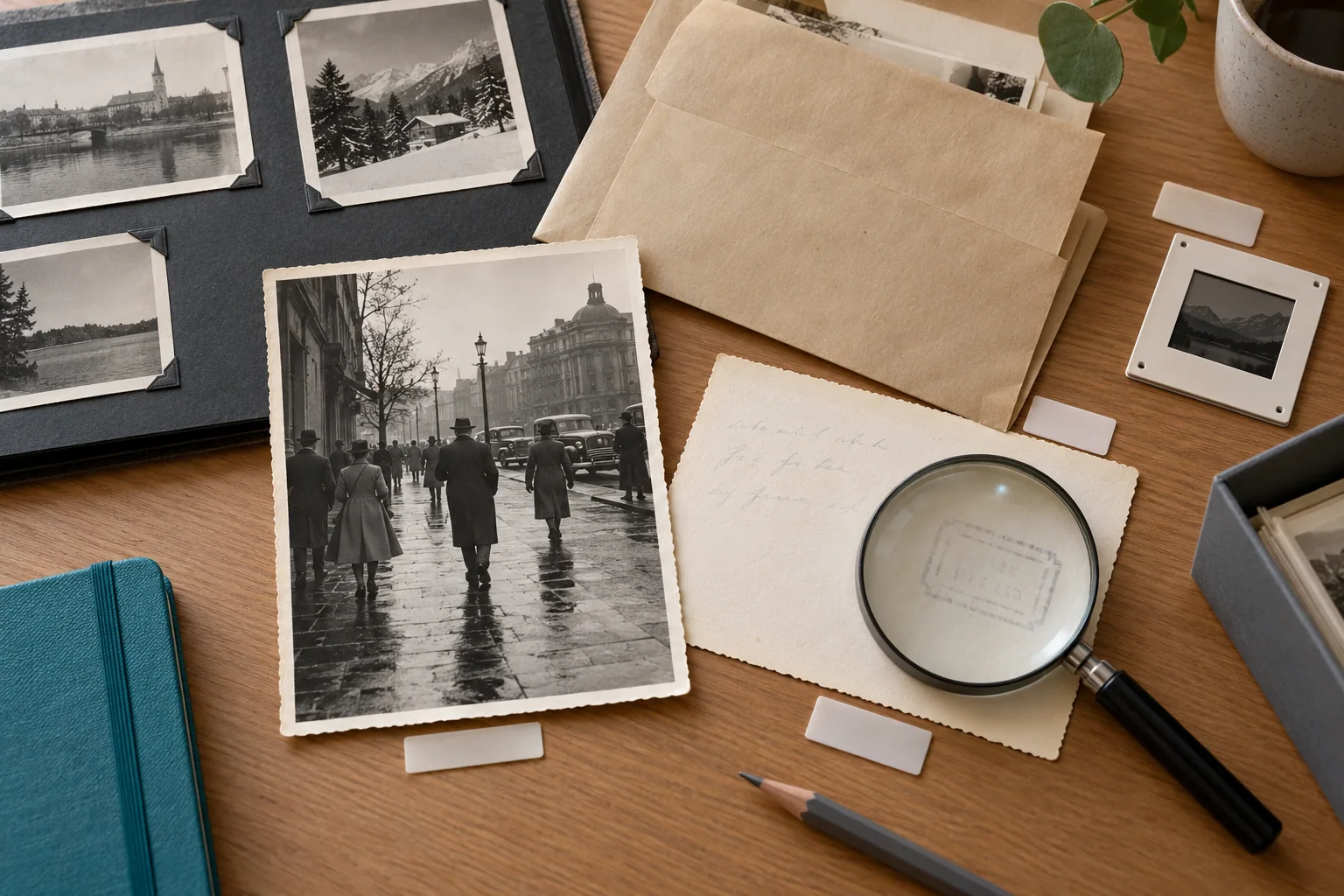
Illustration: preserve the print, reverse, album position, and envelope together; each may hold a different clue.
Keep the photograph and its context together
Before cropping or searching, photograph both sides of the print. Note captions, stamps, photographer imprints, handwritten numbers, and anything attached to the album page. Preserve the envelope, slide mount, or box and its order alongside neighboring images. A name on the back could identify a person or studio; verify its role. In a museum account of investigating unidentified slides, researchers explain why mounts, containers, and nearby records can matter, and why a processing stamp need not give the exposure date.
Keep an untouched scan and use a stable ID such as Album-2-014 in every note. If you later find an old photo's location, the evidence will still be tied to the right print. A file creation date on a modern scan usually tells you about digitization or transfer, not when the scene was photographed. Check any available metadata, but do not expect the scan to recover the original camera's position.
Read the scene without deciding too soon
Write down what you can actually see before searching for a match: the spelling on a sign, a partial street number, the sequence of windows, a bridge rail, the shape of a roof, or a distinctive slope. Separate exact observations from guesses. ‘Three arched upper windows’ is an observation; ‘the old courthouse’ is a hypothesis. Search a clear crop of the building or sign if it helps, but retain the full frame because adjacent structures and road layout may be more distinctive.
To identify the location of an old photo, compare combinations of features, not just one attractive resemblance. Storefronts change; familiar building designs recur. Ask where the photographer could have stood and whether the visible street, shadows, building order, and terrain fit that viewpoint. The question “Where was this old photo taken?” becomes easier to answer when two or three fixed features line up in the same arrangement. Do not use details generated by AI restoration as evidence; compare the original pixels or print.
Use family memory to narrow the search area
A relative may remember the occasion better than the street. Ask specific, neutral questions: Who owned the camera? Who lived near this store? Was the picture taken before or after the family moved? Do you recognize the coat, car, school uniform, or person standing just outside the frame? What event do the neighboring pages show? Ask before suggesting a town. Record who said it, when, and whether they saw the place themselves or heard the story later.
Family timelines can help locate an old photograph without pretending that every move fixes a date. A residence, school, job, or visit suggests a region and date range. Cross-check it against the print: does the visible business name fit that period, and could the pictured people plausibly have been there? If the answer is unclear, keep multiple candidates. That restraint matters when “Where was this old photo taken?” becomes part of a family record that others will repeat.
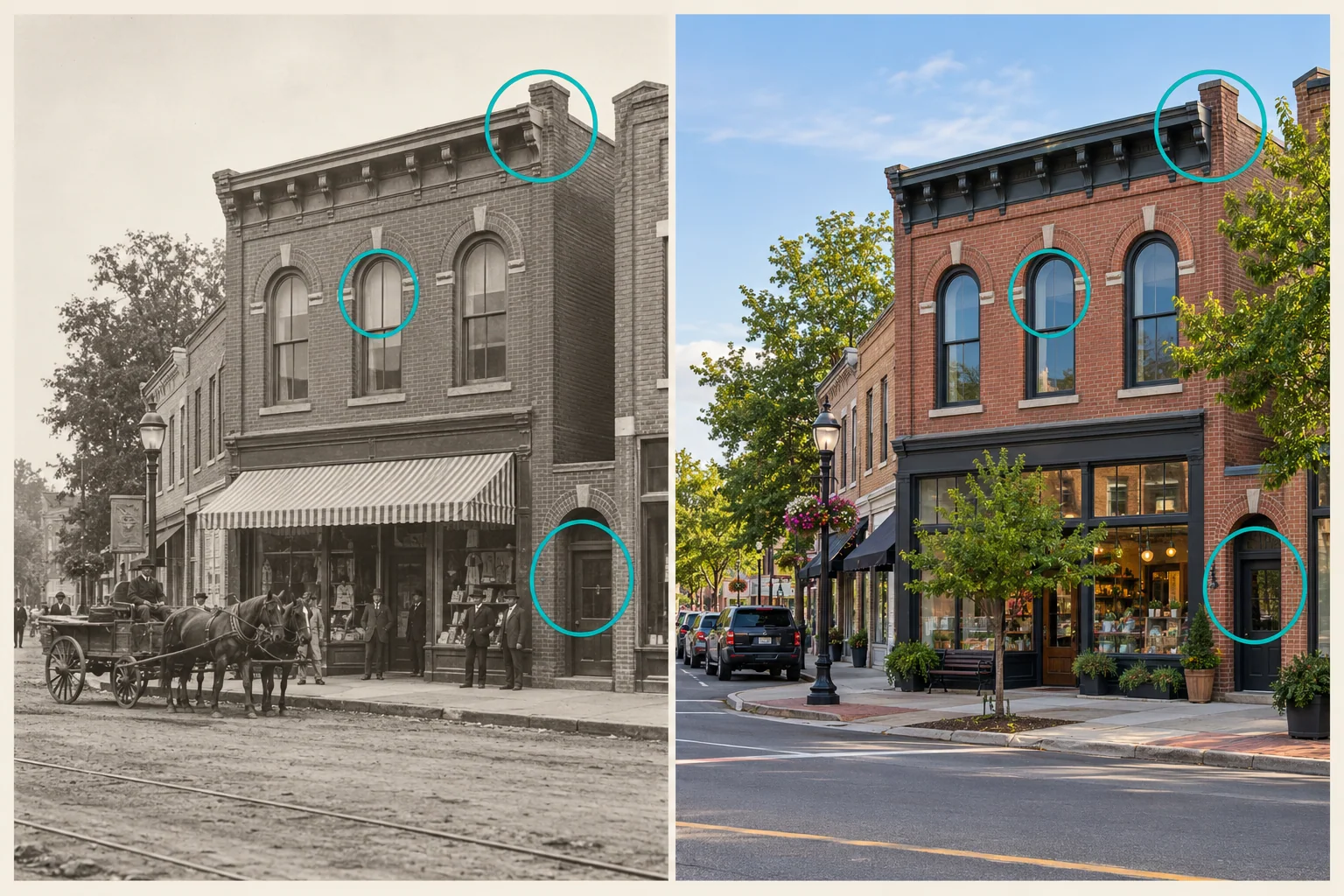
Illustration: stable building features can support a candidate even when shop names and street surfaces have changed.
Test a candidate place against historical records
Search for the exact words you can read, plus a plausible town and approximate decade. Then try local library photo collections, historical society catalogs, city directories, historic maps, and digitized newspapers. The Library of Congress Prints & Photographs catalog is another starting point for image searches; coverage varies, so an empty search is not proof that a place did not exist. Catalog descriptions may also use older street or neighborhood names. Keep a link for each useful result.
To find an old photo's location, compare a dated archival image or map with the family print at the level of street geometry and neighboring buildings. A directory can place a business at an address during a certain year; a map may show the street alignment; a separate photograph may confirm the facade. These sources answer different questions. Reposts of one image or retellings of one family story are not independent confirmation.
Modern maps can help orient a candidate, but demolition, renumbering, and changed street names can obscure a real match. If a current image disagrees, check dated records. Label a visual resemblance ‘candidate’ until address and viewpoint agree. This is the difference between an old photo location lead and a supported identification.
Try visual location suggestions, then verify them
If the scene has enough visible detail, you can upload a scan to WhereIsPhoto as one more source of leads. It accepts JPG, PNG, or WEBP files up to 8 MB and returns up to three AI location candidates with maps and visual clues. You can try even without GPS data. Sign-in is required, and each attempt uses one credit. A public-image match or AI suggestion does not establish the original shooting spot, especially when an older streetscape has changed.
Still asking “Where was this old photo taken?” Treat a suggested city as a search term, not a verdict. Recheck the physical print, ask relatives, and seek a dated map, directory, or photograph that supports the same address. If you want to explore possible map positions after gathering those clues, start with the photo location tool and record its suggestions separately from verified sources.
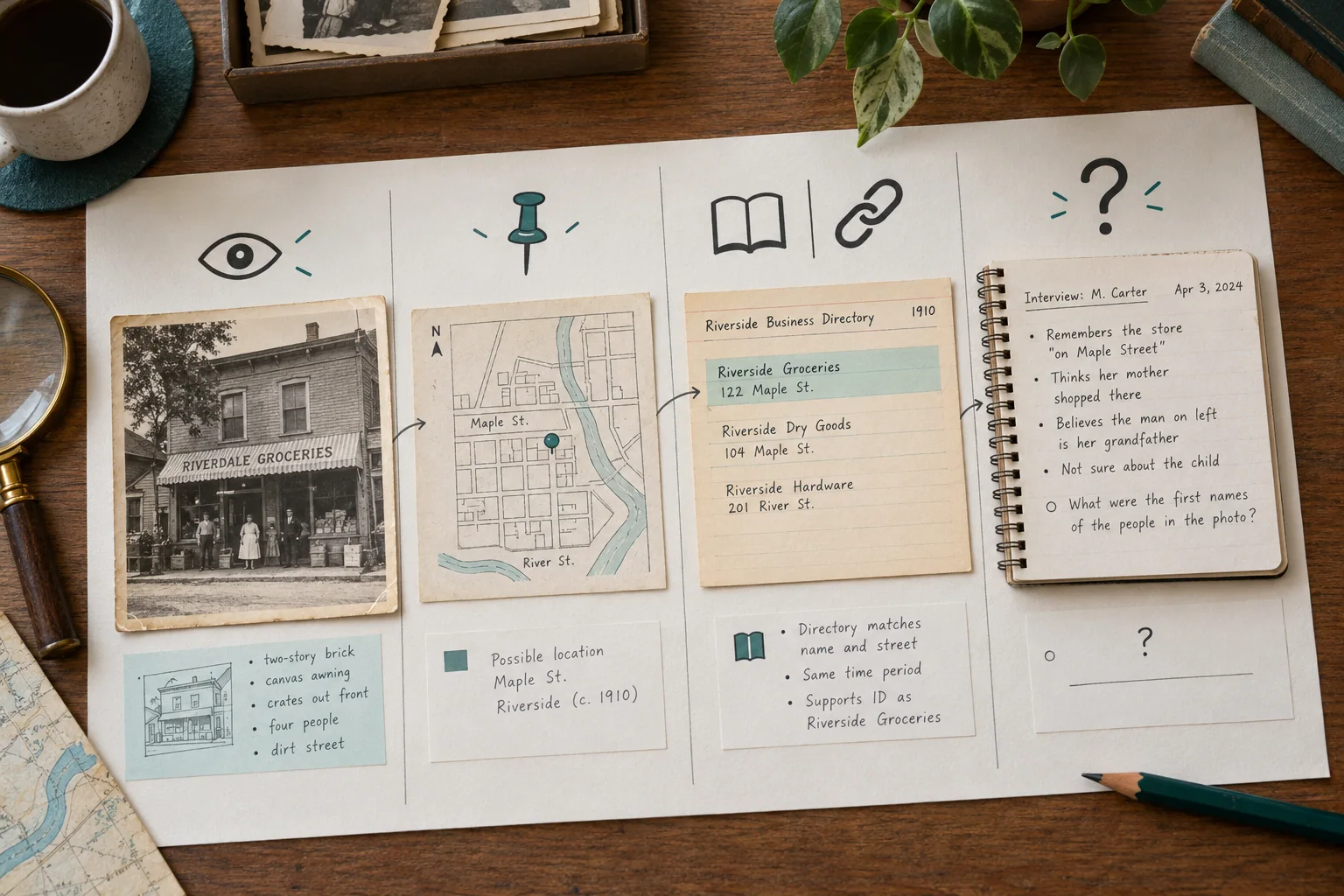
Illustration with fictional notes and records: to investigate “Where was this old photo taken?”, keep observations, candidate places, source records, and unresolved checks separate.
Keep a research record someone else can check
Copy this template into a spreadsheet or notebook for every candidate. The row is a fictional example of how to organize a lead:
| Photo ID | Observed clue | Candidate place and date range | Source and link | What this source actually supports | Contradiction or missing check | Status |
|---|---|---|---|---|---|---|
| Album-2-014 | Three arched upper windows | Town and address to test; decade uncertain | Catalog record or family interview | Building shape or a remembered visit | Need a dated street view and matching viewpoint | Candidate |
Use plain status labels: unexamined, candidate, plausible, supported, or unresolved. ‘Supported’ should mean independent evidence agrees on the place and the view, with no material contradiction left unexplained; it does not mean perfect certainty. Save stable record details and the consultation date. Keep rejected candidates and why they failed.
When the place stays unknown
You may identify a region but never reach a street address. Record that narrower result and its limits. ‘Probably near the family's former home, based on an interview; no matching streetscape found’ is more useful than a confident but unsupported pin. Continue to locate an old photograph by checking other prints in the same sequence or asking someone who knew the people pictured. The most responsible answer to “Where was this old photo taken?” is sometimes a set of possibilities and a clear next clue to seek.